
Комуникация в медиите и обществото
Communication in Media and Society
DOI 10.55206/EVJX8965
Milen Filipov
American University in Bulgaria, Blagoevgrad, Bulgaria
E-mail: mfilipov@aubg.edu
Nilufar Sulaimonova
KIMEP University, Almaty, Kazakhstan
E-mail: nilufar.sulaimonova@kimep.kz
 Abstract: The rapid digitalization of Central Asia has produced a complex information environment in which the pace of digital adoption frequently surpasses the development of media oversight. In Kazakhstan, the convergence of high platform dependence and evolving political regulations underscores the importance of studying information integrity for regional stability and democratic discourse. This article investigates the operation of fact-checking on social media in Kazakhstan from 2017 to 2025, employing a structured narrative review of 54 scholarly and institutional sources. Utilizing the information disorder framework and hybrid media system theory, the analysis is conducted at the structural, institutional, and societal levels. The findings indicate that misinformation circulates through a unique combination of concentrated platform use, regulatory displacement into private messaging channels, linguistic segmentation between Kazakh and Russian spheres, and temporal asymmetry between claims and corrections. Fact-checking, led by Factcheck.kz and Stopfake.kz, is professionally recognized but institutionally fragile, functioning under governance conditions that influence both its agenda and reach. At the audience level, an exposure–correction gap, a youth literacy paradox, and weak institutional trust limit the effectiveness of corrections. This study is significant as it addresses an empirical gap by focusing on fact-checking as a specific institutional response rather than general misinformation. Assessing the application of global theories within a hybrid media system offers a structured framework for scholars and practitioners to understand the conditions necessary for effective verification in politically sensitive, platform-dominated environments.
Keywords: fact-checking, misinformation, Kazakhstan, social media, hybrid media system, information disorder, media literacy, Central Asia.
Introduction
Misinformation and disinformation are major challenges for public discourse in the digital age. The expansion of social media, advances in AI, and wider use of data-driven communication have sharply increased the scale, speed, and sophistication of false information (Posetti & Matthews, 2018). [1] Platforms that focus on engagement favour sensational or polarizing content, amplifying it over verified information (Lim et al., 2025). [2] Misleading claims often reach the public before journalists or fact-checkers can address them.
Wardle and Derakhshan [3] use the framework of information disorder, separating misinformation (false information shared without intent to harm), disinformation (deliberately created to mislead), and malinformation (strategic use of real information in harmful ways). In this changed environment, fact-checking has evolved from corrective journalism into a distinct verification function aimed at restoring credibility in digital communication (Graves, 2018). [4] In this study, “fake news” is a subtype of disinformation: fabricated or heavily distorted content that mimics legitimate journalism to mislead (Tandoc et al., 2018). [5] All types of information disorder can erode trust in news and public institutions, making verification harder and more exhausting for audiences (Guess et al., 2020). [6]
Research on fake news surged after 2017, fuelled by computational propaganda, coordinated inauthentic behaviour, and AI-assisted fabrication (Chesney & Citron, 2019). [7] Deepfakes are further disrupting verification and eroding public trust (Bennett & Livingston, 2018). [8] Tandoc et al. (2018) [9] distinguish seven types of fake news sorted by intent and degree of deception. Users often rely on layered credibility cues – source reputation, message characteristics, and social endorsement – when evaluating online content (Guriev & Treisman, 2019). [10] When these cues are weak or conflicting, audiences may turn to fact-checking organisations. Yet the effectiveness of fact-checking is conditional: it depends on visibility, trust, timing, repetition, and the surrounding political and media environment (Walter, Cohen, Holbert, & Morag, 2020). [11] A major limitation in the literature is its focus on Western democratic media systems, which limits understanding of misinformation in hybrid or semi-authoritarian contexts where misinformation circulates under different structural conditions (Guriev & Treisman, 2019). [12]
Kazakhstan shows how misinformation and fact-checking connect to technology and politics in Central Asia. The country combines high digital connectivity – internet penetration of about 93 per cent, with TikTok (15.7 million users), Instagram (12.4 million), and YouTube (12–13 million) as leading platforms (DataReportal, 2024) [13] – with a politically constrained media environment. Freedom House (2020) [14] classifies Kazakhstan as “Not Free,” and the IREX Media Sustainability Index (2022) [15] indicates weak editorial independence and media pluralism. These conditions mean misinformation in Kazakhstan stems from both technology and deep-rooted political and structural factors.
Kazakhstan’s dual-language media environment adds further complexity: information circulates across Kazakh- and Russian-language spheres, creating distinct narrative flows and uneven access to verified content (Demoscope, 2022). [16] This linguistic dimension is particularly important for younger users, whose platform use is often intensive but whose access to consistently fact-checked content may vary across languages and platforms. Younger users often have difficulty recognising propaganda and identifying distorted information (UNESCO, 2025). [17] Many Kazakhstani media users frequently encounter disinformation (Akkalieva, 2025) [18], and this issue is now seen as a policy and communication challenge, not simply a media literacy one (Sultanbayeva et al., 2025). [19]
Kazakhstan’s legal and regulatory environment is central to understanding misinformation dynamics. Article 274 of the Criminal Code [20] criminalises knowingly spreading false information. The Law on Online Platforms and Online Advertising [21] reinforces a security-focused approach, penalising influencers and platforms for sharing false information that threatens the constitutional order. The Law on Mass Media [22] requires state monitoring of content to ensure compliance with national and cultural values. This large number of regulations creates ambiguity that can discourage public debate on sensitive claims and displace discourse into private messaging channels (Guriev & Treisman, 2019). [23]
This study is grounded in the information disorder framework (Wardle & Derakhshan, 2017) [24] as the primary analytical lens, supplemented by Chadwick’s [25] theory of the hybrid media system, which conceptualises the interplay between older broadcast logics and newer networked logics as the defining feature of contemporary political communication. Additional theoretical resources include agenda-setting (McCombs, 2014) [26] and gatekeeping (Shoemaker & Vos, 2009). [27], the networked public sphere (Bennett & Segerberg, 2013) [28], and work on digital authoritarianism (Greitens, 2020). [29] In Kazakhstan, official narratives produced through state-aligned media are continuously reframed or contested by networked actors on Telegram, TikTok, and Instagram, while state-affiliated communicators use those same platforms to amplify preferred messages. Fact-checking therefore functions not as a neutral technical procedure but as a site of interaction between competing media logics: the top-down authority of traditional institutional sources, and the bottom-up logic of networked verification and contestation.
Despite the growing visibility of misinformation and the emergence of local fact-checking initiatives such as Factcheck.kz, there is still no integrated account of how fact-checking operates in Kazakhstan across structural, institutional, and societal levels. A widely cited example is Factcheck.kz’s 2017 review of a public statement by then-Minister Tamara Duisenova, who denied gender-based pay discrimination – which Factcheck.kz concluded was false using official statistics. This case illustrates both the public importance of fact-checking and the risks associated with contesting claims made by authoritative actors. The study addresses three research questions:
RQ1. What patterns and dominant forms of misinformation are documented in Kazakhstan’s social-media environment between 2017 and 2025?
RQ2. What is known about fact-checking actors, verification practices, and the influence of legal and political constraints?
RQ3. What evidence exists regarding audience reach, trust, and the effectiveness of fact-checking interventions?
Literature review
The platform-amplification literature has established a broad consensus that misleading content enjoys structural diffusion advantages (Vosoughi et al., 2018). [30] This claim, however, rests on a narrower empirical base than often acknowledged Vosoughi, Roy, and Aral’s landmark study is platform-specific (Twitter), period-specific (2006–2017), and genre-specific (news cascades). Bakshy and colleagues [31] and Gillespie [32] are frequently cited together but are analytically distinct – the former a Facebook-specific quantitative analysis, the latter a qualitative governance critique. A substantive disagreement concerns how political context mediates these dynamics. Bennett and Livingston (2018) [33] locate disinformation within systemic democratic decline, while Guriev and Treisman (2019) [34] emphasise strategic information control by informational autocrats.
The Walter et al. (2020) [35] meta-analysis reports a meaningful but modest corrective effect for fact-checking, synthesising mostly experimental studies in democratic contexts. Moderators such as source credibility, timing, and prior beliefs substantially attenuate outcomes; effect durability remains contested. Two unresolved debates – whether corrections persist beyond initial exposure, and whether backfire effects operate in politically charged domains – mean that the evidence supports conditional rather than universal conclusions. Graves (2018) [36] and Amazeen (2015) [38] offer well-supported accounts of fact-checking professionalization, but their arguments about institutional consolidation are weaker as generalizations beyond Western contexts.
A substantial body of Kazakhstan-specific scholarship has developed since 2018, published primarily in the Herald of Journalism (KazNU) and the Bulletin of L.N. Gumilyov ENU. This literature clusters around fact-checking practice, disinformation patterns during COVID-19 and elections, media literacy and journalistic education, and legal regulation. The convergent finding is that Factcheck.kz serves as the anchor institution, disinformation intensifies during high-salience events, media literacy provision remains fragmentary, and no unified legal framework specifically governs disinformation. The most significant absence is audience-level evidence: the Kazakhstan-specific literature documents exposure and institutional practice but not how corrections are received or whether trust mediates effectiveness.
Methodology
The study employs a structured narrative literature review, a design appropriate when the evidence base is limited, unevenly distributed, and methodologically heterogeneous (Ferrari, 2015). [37] Structured narrative reviews are methodologically defensible when they clearly specify objectives, search strategy, source selection criteria, and synthesis logic (Snyder, 2019). [38] The review synthesises 54 sources published between 2017 and 2025, combining peer-reviewed scholarship with institutional reports from Freedom House, IREX, UNESCO, and DataReportal. The source base draws on both international scholarship and a growing national research literature published in Kazakhstani journalism journals.
Academic searches were conducted in Google Scholar, Scopus, Web of Science, EBSCO, and ProQuest using two-concept search strings (e.g. “fact-checking AND Kazakhstan,” “disinformation AND Central Asia,” “media literacy AND Kazakhstan”). Targeted searches of national journal archives supplemented the database results. The search proceeded in stages: broader global search strings were used first to identify theoretical and conceptual literature, then refined into Kazakhstan- and Central Asia-oriented searches to locate contextual and regionally relevant sources.
Sources were included if they were published between 2017 and 2025 (with exceptions for foundational methodological works), were thematically relevant to misinformation, fact-checking, media literacy, or hybrid media systems, and contributed either to the global conceptual framework or to Kazakhstan-specific empirical understanding. Grey literature was included only from established organisations and only where peer-reviewed Kazakhstan-specific evidence was unavailable (Adams et al., 2017). [39] Excluded materials included opinion pieces, unsubstantiated blog posts, advocacy materials without evidentiary basis, and sources lacking a direct connection to the research topic.
The sources were organised into a literature matrix classifying each by author, year, source type, empirical context, method, and analytical level (structural, institutional, or societal). The synthesis was thematic rather than chronological, structured around the interaction of these three levels.
Limitations include reliance on English-language and internationally indexed materials, which may underrepresent Kazakh- and Russian-language scholarship. The Kazakhstan-specific evidence base remains predominantly descriptive and cross-sectional, with limited longitudinal or impact-oriented analysis. The synthesis is partly interpretive; it does not claim the status of a formal systematic review. These limitations define the evidentiary boundaries within which the conclusions should be interpreted.
Findings
Structural findings: misinformation circulation in Kazakhstan
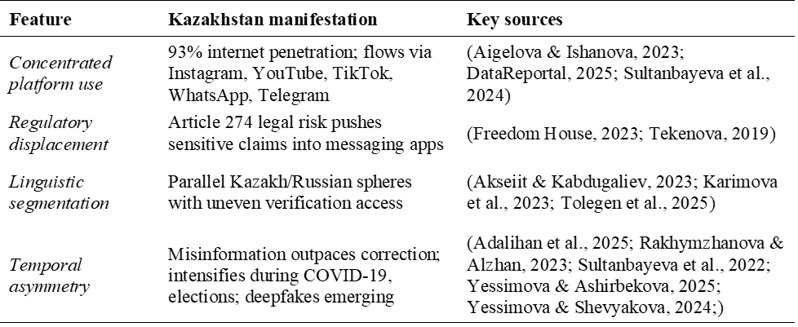
Four structural features shape misinformation circulation in Kazakhstan. The first is the combination of very high digital connectivity with concentrated use of a small number of platforms. DataReportal (2025) [40] documents internet penetration above 93 per cent, with most consumption occurring on mobile devices and heavily concentrated on Instagram, YouTube, TikTok, WhatsApp, and Telegram. This platform concentration amplifies the general diffusion dynamics identified in the wider literature, because a small number of channels carry a disproportionate share of everyday information flows (UNESCO, 2025). [41] The finding is not simply that misinformation travels quickly, but that in Kazakhstan it travels through a narrow set of channels with distinct affordances – algorithmic feeds on Instagram and TikTok, messaging infrastructure on WhatsApp and Telegram – that require correspondingly distinct verification strategies.
The second structural feature is regulatory displacement. The general literature notes that restrictive environments may push misinformation into less visible spaces (Guriev & Treisman, 2019). [42] In Kazakhstan, the legal architecture – particularly Article 274 of the Criminal Code and the Law on Online Platforms – provides a concrete mechanism for this displacement. Public, searchable content carries legal risk; private and semi-private channels do not. The integrated finding is that Kazakhstan’s regulatory environment does not so much suppress misinformation as redistribute it across a visibility gradient, with the most politically sensitive claims concentrated in messaging apps where fact-checking organisations have limited monitoring capacity (Bennett & Livingston, 2018). [43]
The third structural feature is linguistic segmentation. Information circulates across Kazakh- and Russian-language spheres that overlap but do not fully converge, producing distinct narrative flows and exposure patterns within the same national audience (Guess et al., 2020). [44] This segmentation compounds platform fragmentation, because users in each language sphere encounter different sources, influencers, and verification ecosystems. A correction produced in one language sphere may never reach an audience exposed to the original claim in the other.
The fourth structural feature is temporal asymmetry between circulation and correction. Kazakhstan-specific conditions intensify this asymmetry Demoscope [45] indicates widespread routine exposure to disinformation, and Sultanbayeva, Gorbunova, and Lozhnikova (2022) [46] document the spread of fake and inaccurate information across Kazakhstani social networks, while the small number of operating fact-checking actors means that the volume of material needing verification substantially exceeds verification capacity (Chesney & Citron, 2019). [47] Event-specific studies reinforce this point: Rakhymzhanova and Alzhan (2023) [48] and Sultanbayeva et al., (2022) [49] show that the COVID-19 period produced a surge of disinformation that outpaced verification response, while Yessimova and Ashirbekova (2025) [50] document similar dynamics during election periods. The mismatch is not only qualitative but quantitative and event-contingent.
A further observation is that the content of disinformation is evolving. Yessimova and Shevyakova (2024) [51] document the emergence of deepfakes in Kazakhstan’s information environment, and Adalihan, Skripnikova, and Shyngyssova (2025) [52] raise the related question of generative AI and its implications for journalistic verification. The structural configuration identified here is not static: the types of misinformation are becoming increasingly sophisticated, adding further temporal pressure on an already under-resourced verification field.
Table 1. Structural features of misinformation circulation in Kazakhstan
This reconfiguration marks a partial shift from traditional gatekeeping toward what Bruns (2018) [53] calls gatewatching, in which networked users observe, curate, and challenge claims in real time. In Kazakhstan, gatewatching practices are visible but thinly distributed, coexisting with older gatekeeping structures that continue to shape which claims receive institutional authority Guz (2018). [54]
Institutional findings: fact-checking under constraint
Fact-checking in Kazakhstan is anchored by Factcheck.kz and Stopfake.kz. National scholarship has documented their development, compared their operational features, and traced an evolution from binary true/false verdicts toward more nuanced explanatory forms – a development broadly consistent with international trends noted by (Ibraiymov et al., 2025). [55] The 2017 Factcheck.kz review of then-Minister Duisenova’s denial of gender-based pay discrimination illustrates that local fact-checking can contest claims by senior officials using publicly available evidence. Yet the ecosystem remains institutionally thin: it has few consolidated actors, limited funding, and no dense organisational network comparable to those documented in Western contexts (Karimova et al., 2023. [56] The synthetic finding is that Kazakhstan has fact-checking practice – and now a documented national research literature about that practice – but not yet a fact-checking field in the organisational sense.
The governance conditions under which verification operates represent a central finding. Kazakhstan’s regulatory architecture combines criminal, communications, and administrative provisions without a unified disinformation statute (Tolegen et al., 2025). [57] The legal ambiguity creates a dual dynamic: the same statutory language that could sanction misinformation also threatens independent fact-checkers who contest politically sensitive claims. This dual dynamic distinguishes fact-checking in hybrid media systems from fact-checking in fully democratic ones: in democratic contexts, the primary challenge is typically visibility and audience engagement; in Kazakhstan, the challenge also includes navigating a political environment in which contesting certain claims carries institutional and legal risk. The integrated finding is that this architecture shapes not only what can be published but what is likely to be selected for verification, producing an implicit agenda effect.
A structured mismatch exists between the preconditions for effective fact-checking identified in the international literature – timeliness, source credibility, and distribution – and conditions available in Kazakhstan. Timeliness is constrained by capacity; source credibility is complicated by the political environment; and distribution lacks the platform partnerships available elsewhere. Fact-checking competencies are also inconsistently embedded in journalism education (Freedman & Karimova, 2018) [58], bounding the pipeline of trained verification staff. The institutional gap is not a generic resource deficit but a structured mismatch between the conditions for impact identified by the evidence and what the Kazakhstani environment currently provides.
Societal findings: audience reception
An exposure–correction asymmetry structures audience reception: Kazakhstani users encounter misinformation frequently and across multiple platforms, while the institutional findings indicate that corrections reach comparatively narrow audiences. The gap between exposure and correction is not incidental but structural: it follows directly from concentrated platform use, regulatory displacement, and linguistic segmentation.
Younger audiences occupy a contradictory position – UNESCO (2025) identifies uneven media literacy in Kazakhstan. [59] Abueva, Buzelo, and Abuev (2025) [60] document pedagogical gaps in fact-checking education. Kazakhstan-focused scholarship on media literacy reinforces this picture. Media literacy as a central institutional countermeasure against disinformation and find its national implementation to be fragmentary (Abueva et al., 2025). [61] Freedman (2020) [62], found pedagogical gaps in how fact-checking and critical evaluation skills are taught within Kazakhstani higher education. Combined with the general literature on the distinction between digital fluency and critical evaluation, this produces a youth paradox sharpened by dual-language platform use and uneven educational provision: high engagement does not translate into proportionate critical capacity, and the pedagogical infrastructure needed to close that gap is itself underdeveloped.
A further dimension relevant to the hybrid media system framing is linguistic hybridity. Narratives in Kazakhstan do not circulate within a single language community but cross the Kazakh- and Russian-language segments of the information environment, often carrying different inflections, framings, and implied audiences. The same claim can acquire different evidentiary weight and different levels of contestation depending on which linguistic segment of the hybrid system it appears in. This compounds the reception challenges, because fact-checking responses produced in one language sphere may not reach, or be trusted by, audiences whose primary exposure is in the other.
Trust operates as a limiting condition rather than a background variable. Corrections must establish credibility in an environment where institutional trust is fragile and where any verification source may be read through a political lens (Reporters Without Borders, 2024). [63] Kazakhstan-specific research suggests that audience engagement with Factcheck.kz and Stopfake.kz is uneven and that perceptions of independence vary across audience segments. This is a qualitatively different reception condition from that assumed in most of the general literature.
Integrated finding: the reinforcing pattern
The central integrated finding is that the three levels do not act independently; they reinforce one another in ways that compound the challenge of countering misinformation. Structural features – concentrated platform use, regulatory displacement, linguistic segmentation, and temporal asymmetry – generate misinformation circulation patterns that exceed the monitoring and response capacity of the institutional field. Institutional thinness and governance constraints limit the reach, speed, and credibility of corrections that do get produced. Audience-level conditions – the exposure–correction gap, youth literacy paradox, and trust deficit – then mediate whether corrections that reach audiences are accepted or resisted.
Each level feeds back into the others: limited institutional reach reinforces structural asymmetry by producing fewer, later corrections; audience scepticism reduces incentives for institutional expansion; linguistic and platform fragmentation lower the marginal return on any single institutional investment. The challenge in Kazakhstan is not misinformation alone, nor fact-checking capacity alone, nor audience vulnerability alone, but the way these three levels mutually reinforce one another to produce a configuration in which fact-checking is possible, professionally practised, and publicly valuable – and yet systematically outmatched.
Answers to the research questions
RQ1. Patterns and dominant forms of misinformation in Kazakhstan (2017–2025).
The review identifies a distinctive structural configuration where misinformation behavior is dictated by four factors:
- Platform displacement: High concentration on Instagram, TikTok, and YouTube, with sensitive political claims moving to private messaging apps (WhatsApp/Telegram) to bypass regulation (Seitzhanova et al., 2021). [64]
- Linguistic segmentation: Parallel, non-overlapping information flows between Kazakh- and Russian-language spheres.
- Temporal asymmetry: The speed of viral misinformation (notably during COVID-19 and elections) consistently outpaces the capacity of verification infrastructure (Aigelova & Ishanova, 2023). [65]
- Evolution of form: A rise in AI-assisted content, such as deepfakes, alongside traditional misinformation originating from institutional actors (Kaldybekova, 2025). [66]
RQ2. Fact-checking actors, practices, and the influence of legal and political constraints.
Fact-checking in Kazakhstan is professionally established but operationally constrained:
- Institutional fragility: Leading actors like Factcheck.kz and Stopfake.kz lack the funding and platform partnerships common in Western contexts (Akseiit & Kadbugaliev, 2023). [67]
- Implicit agenda setting: Legal and political architectures (Tekenova, 2019) [68] influence not only what can be safely published but also which claims are prioritized for verification.
- Bounded impact: Effectiveness is limited by uneven timeliness and distribution, which restricts the reach of corrections regardless of their quality (Beimisheva et al., 2019). [69]
RQ3. Audience reach, trust, and effectiveness of fact-checking interventions.
Evidence regarding reception remains thin, but three substantive conclusions emerge:
- Exposure–Correction gap: The gap between seeing a claim and its correction is driven by structural platform conditions rather than just audience behavior (Ibraiymov et al., 2025) [70]
- The Literacy paradox: Younger audiences exhibit high platform proficiency but lack corresponding critical evaluation skills (UNESCO, 2025). [71]
- Trust as a limit: Fragile institutional trust acts as a cap on effectiveness; corrections cannot change minds if the source of the correction is not viewed as credible within the local political context (Yessimova & Yertassova, 2024). [72]
Table 2. Research questions mapped to integrated findings and evidentiary base
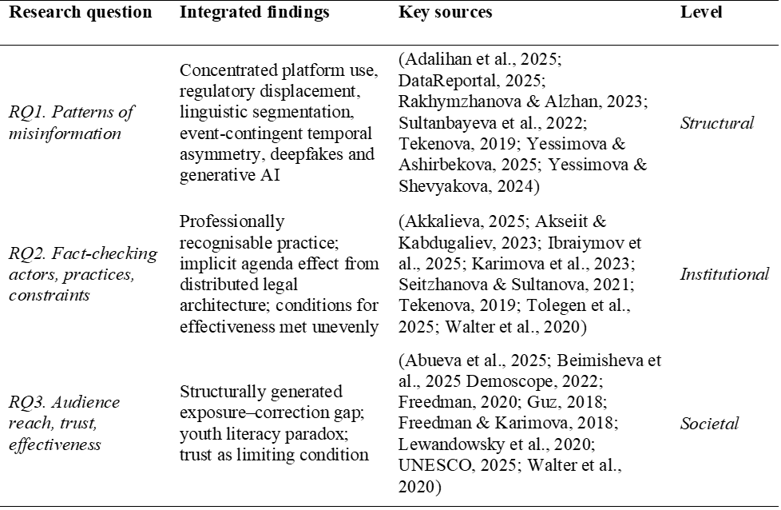
Table 2 makes the integrated logic of the three answers visible. Each research question is answered by drawing on a combination of Kazakhstan-specific and general sources, and the analytical level column shows how the three answers together span the structural, institutional, and societal levels of the framework. The table also clarifies a limitation: the RQ3 answer rests more heavily on contextual Kazakhstan-specific literature and global reception research than on direct audience measurement in the Kazakhstan case, consistent with the evidentiary limits noted in the literature review.
Discussion
The findings confirm that misinformation in Kazakhstan is structural, not merely a content problem. This is consistent with the broader literature on platform amplification and with the information disorder framework, which emphasises that the conditions of circulation – not just the falsity of individual claims – determine the severity of the problem. However, Kazakhstan adds a second structural layer absent from the predominantly Western literature: the regulatory and political environment actively shapes which claims circulate openly, which are displaced into private channels, and which remain uncontested due to self-censorship. This pattern complicates the standard platform-centric model by showing that political structure and platform structure interact to shape misinformation dynamics.
This finding has theoretical implications. The information disorder framework, as articulated by Wardle and Derakhshan, primarily classifies misleading content by intent and falsity. It is less developed as a framework for analysing the political economy of information circulation – the institutional and regulatory conditions that determine which types of disorder become visible and which remain hidden. The Kazakhstan case suggests that, in hybrid media systems, the concept of information disorder should be extended to account for how state regulation, legal ambiguity, and media control interact with platform logics to shape the distribution of misinformation.
The hybrid media system framework sharpens this observation. Regulatory displacement is a symptom of hybridity itself – the coexistence of older broadcast logics under traditional legal constraints with newer networked logics operating under weaker oversight. In Kazakhstan, politically sensitive discourse that would carry legal risk in state-regulated broadcast spaces is routinely rearticulated in WhatsApp groups and Telegram channels. The result is a communicative space that is simultaneously hyper-visible and semi-secret. What might be termed asymmetric transparency and characterises this system: the state uses networked platforms for its own messaging while using traditional legal instruments to penalise independent verification on those same platforms. The networked layer is not uniformly more open than the broadcast layer; it is selectively open, favouring actors with institutional resources.
At the institutional level, Factcheck.kz functions as what might be called a hybrid bridge-builder: it applies traditional journalistic rigour – cross-referencing official statistics, tracing claims to primary sources – but distributes findings through the viral grammar of social media, including infographics and short videos optimised for Instagram and Telegram. This dual orientation is how a resource-constrained verification organisation reaches audiences who no longer depend on traditional gatekeepers, while still producing content that is evidentially defensible by journalistic standards. The institutional identity of fact-checking in Kazakhstan is therefore neither purely “legacy” nor purely “networked” but genuinely hybrid.
At the same time, the hybrid lens reveals a second dynamic: the emergence of what can be described as state-aligned fact-checking, in which verification-adjacent formats are used primarily as tools of reputation management rather than as instruments of independent public accountability. Under hybrid conditions, fact-checking as a format can be adopted by actors pursuing very different goals. Independent verification and state-aligned counter-messaging may share surface features – evidence claims, visual framing, platform-native distribution – while operating from opposed institutional logics. This tension is a consequence of hybridity, and any evaluation of fact-checking effectiveness in Kazakhstan must take it into account.
The societal findings point to a fundamental challenge: even accurate, available fact-checking faces a credibility barrier when institutional trust is fragile. Audiences may discount corrections not because the information is poor but because the source is not trusted or is perceived as politically aligned. This aligns with the broader consensus that corrections are more effective from credible, independent sources but highlights the difficulty of establishing such credibility where media independence itself is constrained. Improving fact-checking effectiveness in Kazakhstan requires attention not only to the quality and accuracy of corrections, but also to the conditions of reception: building audience trust, strengthening media literacy, and ensuring that corrective content reaches diverse audiences across linguistic and platform boundaries.
The study makes three contributions. First, it provides an integrated multi-level account of fact-checking in Kazakhstan’s hybrid media system, addressing a gap the reviewed literature consistently identifies but does not fill. Second, it tests the applicability of the information disorder framework in a non-Western context, finding that its utility increases when combined with attention to political and regulatory conditions. In Kazakhstan, the political environment does not merely respond to information disorder but actively contributes to its configuration. Third, it identifies the specific conditions under which fact-checking is constrained in hybrid media environments, offering a framework potentially applicable to other Central Asian and comparable contexts.
For practitioners, strengthening institutional capacity is necessary but insufficient without expanding reach across platforms and language communities and building audience trust through transparency, independence, and consistent professional standards. For policymakers, ambiguously defined legal provisions risk suppressing legitimate fact-checking while failing to address the structural conditions enabling misinformation. A regulatory environment that protects rather than constrains independent verification would be more likely to support effective counter-misinformation efforts. For educators, media literacy interventions should address platform-specific literacy and dual-language information dynamics – including an understanding of algorithmic amplification, the dynamics of private messaging, and the characteristics of dual-language information flows – rather than relying on generic curricula.
Limitations and directions for future research
The conclusions must be interpreted within the boundaries established by the methodology. The study synthesises existing evidence rather than generating new empirical data. Reliance on English-language materials may underrepresent Kazakh- and Russian-language scholarship. The Kazakhstan-specific evidence base remains thin, fragmented, and predominantly descriptive. The reinforcing multi-level pattern identified in the findings is analytically compelling but requires empirical validation through primary research.
Several directions for future research emerge. Primary empirical studies – audience surveys, experimental designs, and in-depth case studies of fact-checking organisations – would significantly strengthen the evidence base. Longitudinal research tracking changes in misinformation patterns, fact-checking capacity, and audience responses over time would address the currently static character of the available evidence. Comparative research situating Kazakhstan within the broader Central Asian and post-Soviet context would help clarify which features of the country’s information environment are distinctive and which are shared. Research incorporating Kazakh- and Russian-language sources would provide a more complete picture of local scholarship and professional practice.
Conclusion
This study set out to examine how fact-checking functions on social media in Kazakhstan between 2017 and 2025 and to assess its role in countering misinformation within a politically constrained yet highly digitalised media environment. Through a structured narrative literature review of 54 sources, the study has shown that misinformation in Kazakhstan is not merely a content problem but a structural, institutional, and societal challenge.
Misinformation benefits from a double structural advantage: platform logics that reward speed and engagement, and a regulatory environment that displaces rather than eliminates false content. Fact-checking has emerged as a visible, professionally grounded response, but it operates under significant institutional constraints and faces an audience environment characterised by uneven media literacy and fragile trust. The central contribution of this article is the identification of a reinforcing pattern across these three levels. Platform amplification, institutional fragility, and audience vulnerability interact in ways that cumulatively limit the effectiveness of fact-checking, even where individual initiatives demonstrate professional competence and public value.
Fact-checking in Kazakhstan is necessary, visible, and professionally meaningful. But it is not yet sufficient to counterbalance the structural and societal conditions that sustain misinformation. Strengthening its effectiveness will require not only better verification practices but also a more enabling regulatory environment, stronger institutional foundations, and deeper engagement with the diverse audiences whose trust and literacy ultimately determine whether corrections succeed.
Acknowledgement: The authors used Grammarly ai to assist with language editing and Claude ai to structure the manuscript according to the requirements of Rhetoric and Communications Journal. All intellectual content, analysis, and interpretations were developed and verified by the authors.
References and Notes
[1] Posetti, J., & Matthews, A. (2018). A short guide to the history of “fake news” and disinformation. International Center for Journalists.
[2] Lim, D., Wai, M. W., Tan, S., & Tandoc, E. C., Jr. (2025). Fact-checking in Asian countries: Routines, roles, and rules. In E. C. Tandoc Jr. (Ed.), Fake news across Asian countries (1st ed., pp. 263–275). Routledge. https://doi.org/10.4324/978100 3403166-23.
[3] Wardle, C., & Derakhshan, H. (2017). Information disorder: Toward an interdisciplinary framework for research and policy making (DGI(2017)09). Council of Europe. https://rm.coe.int/information-disorder-toward-an-interdisciplinary-framework-for-researc/168076277c. Retrieved on 16.04.2026.
[4] Graves, L. (2018). Boundaries not drawn: Mapping the institutional roots of the global fact-checking movement. Journalism Studies, 19(5), 613–631. https://doi.org/ 10.1080/1461670X.2016.1196602.
[5] Tandoc, E. C., Lim, Z. W., & Ling, R. (2018). Defining “fake news.” Digital Journalism, 6(2), 137–153. https://doi.org/10.1080/21670811.2017.1360143.
[6] Guess, A. M., Nyhan, B., & Reifler, J. (2020). Exposure to untrustworthy websites in the 2016 U.S. election. Nature Human Behaviour, 4, 472–480. https://doi.org/ 10.1038/s41562-020-0833-x.
[7] Chesney, R., & Citron, D. K. (2019). Deep fakes: A looming challenge for privacy, democracy, and national security. California Law Review, 107(6), 1753–1819.
[8] Bennett, W. L., & Livingston, S. (2018). The disinformation order: Disruptive communication and the decline of democratic institutions. European Journal of Communication, 33(2), 122–139. https://doi.org/10.1177/0267323118760317.
[9] Tandoc, E. C., Lim, Z. W., & Ling, R. (2018). Defining “fake news.” Digital Journalism, 6(2), 137–153. https://doi.org/10.1080/21670811.2017.1360143.
[10] Guriev, S., & Treisman, D. (2019). Informational autocrats. Journal of Economic Perspectives, 33(4), 100–127.
[11] Walter, N., Cohen, J., Holbert, R. L., & Morag, Y. (2020). Fact-checking: A meta-analysis of what works and for whom. Political Communication, 37(3), 350–375. https://doi.org/10.1080/10584609.2019.1668894.
[12] Guriev, S., & Treisman, D. (2019). Informational autocrats. Journal of Economic Perspectives, 33(4), 100–127.
[13] DataReportal. (2025). Digital 2025: Kazakhstan. https://datareportal.com/reports/digital-2025-kazakhstan. Retrieved on 10.05.2026.
[14] Freedom House. (2023). Freedom on the Net 2023: Kazakhstan. https://freedomhouse.org/country/kazakhstan/freedom-net/2023. Retrieved on 16.04.2026.
[15] IREX. (2022). Media Sustainability Index: Kazakhstan. https://www.irex.org. Retrieved on 16.04.2026.
[16] Demoscope. (2022). Poll: Most Kazakhstani regularly come across disinformation. https://demos.kz/poll-most-kazakhstani-regularly-come-across-disinformation/?lang=en. Retrieved on 16.04.2026.
[17] UNESCO. (2025). Mapping of media and information literacy conducted in Kazakhstan. https://www.unesco.org/en/articles/mapping-media-and-information-literacy-conducted-kazakhstan . Retrieved on 16.04.2026.
[18] Akkalieva, K. M. (2025). Public consciousness and information quality: The impact of fact-checking in Kazakhstan. Eurasian Science Review, 3(5), 36–48. https:// doi.org/10.63034/esr-559.
[19] Tolegen, B. Z., Sultanbayeva, G. S., Mukanov, B., Kalibekuly, D., & Lozhnikova, O. P. (2025). Indicators of disinformation and problems of fact-checking in Kazakhstan [In Kazakh]. Herald of Journalism. https://bulletin-journalism.kaznu.kz/index.php/1-journal/article/download/2020/1469. Retrieved on 16.04.2026.
[20] Criminal Code of the Republic of Kazakhstan. (2014). Article 274: Dissemination of knowingly false information. Law No. 226-V. http://adilet.zan.kz/eng/docs/ K1400000226. Retrieved on 16.04.2026.
[21] Law of the Republic of Kazakhstan. (2023). On online platforms and online advertising. Law No. 211-VII. http://adilet.zan.kz/eng/docs/Z2300000211. Retrieved on 16.04.2026.
[22] Law of the Republic of Kazakhstan. (2024). On mass media. Law No. 451-VI. http://adilet.zan.kz/eng/docs/Z2400000451. Retrieved on 16.04.2026.
[23] Guriev, S., & Treisman, D. (2019). Informational autocrats. Journal of Economic Perspectives, 33(4), 100–127.
[24] Wardle, C., & Derakhshan, H. (2017). Information disorder: Toward an interdisciplinary framework for research and policy making (DGI(2017)09). Council of Europe. https://rm.coe.int/information-disorder-toward-an-interdisciplinary-framework-for-researc/168076277c. Retrieved on 16.04.2026.
[25] Chadwick, A. (2013). The hybrid media system: Politics and power. Oxford University Press.
[26] McCombs, M. (2014). Setting the agenda: Mass media and public opinion. (2nd ed.). Polity Press.
[27] Shoemaker, P. J., & Vos, T. (2009). Gatekeeping theory. Routledge. https:// doi.org/10.4324/9780203930434.
[28] Bennett, W. L., & Livingston, S. (2018). The disinformation order: Disruptive communication and the decline of democratic institutions. European Journal of Communication, 33(2), 122–139. https://doi.org/10.1177/0267323118760317.
[29] Greitens, S. C. (2020). De-democratization and digital repression: How authoritarian states wield connectivity. Brookings Institution.
[30] Vosoughi, S., Roy, D., & Aral, S. (2018). The spread of true and false news online. Science, 359(6380), 1146–1151. https://doi.org/10.1126/science.aap9559.
[31] Bakshy, E., Messing, S., & Adamic, L. A. (2015). Exposure to ideologically diverse news and opinion on Facebook. Science, 348(6239), 1130–1132. https://doi.org/ 10.1126/science.aaa1160.
[33] Gillespie, T. (2018). Custodians of the Internet: Platforms, content moderation, and the hidden decisions that shape social media. Yale University Press.
[33] Bennett, W. L., & Livingston, S. (2018). The disinformation order: Disruptive communication and the decline of democratic institutions. European Journal of Communication, 33(2), 122–139. https://doi.org/10.1177/0267323118760317.
[34] Guriev, S., & Treisman, D. (2019). Informational autocrats. Journal of Economic Perspectives, 33(4), 100–127.
[35] Walter, N., Cohen, J., Holbert, R. L., & Morag, Y. (2020). Fact-checking: A meta-analysis of what works and for whom. Political Communication, 37(3), 350–375. https://doi.org/10.1080/10584609.2019.1668894.
[36] Graves, L. (2018). Boundaries not drawn: Mapping the institutional roots of the global fact-checking movement. Journalism Studies, 19(5), 613–631. https://doi.org/ 10.1080/1461670X.2016.1196602.
[37] Ferrari, R. (2015). Writing narrative-style literature reviews. Medical Writing, 24(4), 230–235. https://doi.org/10.1179/2047480615Z.000000000329.
[38] Snyder, H. (2019). Literature review as a research methodology: An overview and guidelines. Journal of Business Research, 104, 333–339. https://doi.org/10.1016/ j.jbusres.2019.07.039.
[39] Adams, R. J., Smart, P., & Huff, A. S. (2017). Shades of grey: Guidelines for working with grey literature in systematic reviews for management and organizational studies. International Journal of Management Reviews, 19(4), 432–454.
[40] DataReportal. (2025). Digital 2025: Kazakhstan. https://datareportal.com/reports/digital-2025-kazakhstan. Retrieved on 16.04.2026.
[41] UNESCO. (2025). Mapping of media and information literacy conducted in Kazakhstan. https://www.unesco.org/en/articles/mapping-media-and-information-literacy-conducted-kazakhstan. Retrieved on 16.04.2026. Retrieved on 16.04.2026.
[42] Guriev, S., & Treisman, D. (2019). Informational autocrats. Journal of Economic Perspectives, 33(4), 100–127.
[43] Bennett, W. L., & Livingston, S. (2018). The disinformation order: Disruptive communication and the decline of democratic institutions. European Journal of Communication, 33(2), 122–139. https://doi.org/10.1177/0267323118760317.
[44] Guess, A. M., Nyhan, B., & Reifler, J. (2020). Exposure to untrustworthy websites in the 2016 US election. Nature Human Behaviour, 4(5), 472–480. https://doi.org/ 10.1038/s41562-020-0833-x.
[45] Demoscope. (2022). Poll: Most Kazakhstani regularly come across disinformation. https://demos.kz/poll-most-kazakhstani-regularly-come-across-disinformation/ ?lang=en. Retrieved on 16.04.2026.
[46] Sultanbayeva, G. S., Gorbunova, A. A., & Lozhnikova, O. P. (2022). Research, analysis, and assessment of society’s demands for high-quality information during the COVID-19 pandemic [In Russian]. Herald of Journalism. https://bulletin-journalism.kaznu.kz/index.php/1-journal/article/view/1526. Retrieved on 16.04.2026.
[47] Chesney, R., & Citron, D. K. (2019). Deep fakes: A looming challenge for privacy, democracy, and national security. California Law Review, 107(6), 1753–1819.
[48] Rakhymzhanova, L. D., & Alzhan, A. (2023). COVID-19: Analysis of disinformation spread in the media of Kazakhstan in 2020. Bulletin of L.N. Gumilyov Eurasian National University. Journalism Series, 143(2), 40–46. https://buljourn.enu.kz/ index.php/main/article/view/147. Retrieved on 16.04.2026.
[49] Sultanbayeva, G. S., Gorbunova, A. A., & Lozhnikova, O. P. (2022). Research, analysis, and assessment of society’s demands for high-quality information during the COVID-19 pandemic [In Russian]. Herald of Journalism. https://bulletin-journalism.kaznu.kz/index.php/1-journal/article/view/1526. Retrieved on 16.04.2026.
[50] Yessimova, G. A., & Ashirbekova, G. Sh. (2025). Problems of post-truth manipulation in the context of elections. Bulletin of L.N. Gumilyov Eurasian National University. Journalism Series, 151(2), 108–119. https://doi.org/10.32523/2616-7174-2025-151-2-108-119.
[51] Yessimova, M. S., & Shevyakova, T. V. (2024). Deep fakes in the context of information warfare. Herald of Journalism. https://bulletin-journalism.kaznu.kz/index.php/1-journal/article/download/1880/1430/4820. Retrieved on 16.04.2026.
[52] Adalihan, N., Skripnikova, A. I., & Shyngyssova, N. T. (2025). Issues of journalistic ethics in the context of generative artificial intelligence: Based on material from Kazakhstan and China. Bulletin of L.N. Gumilyov Eurasian National University. Journalism Series. https://buljourn.enu.kz/index.php/main/article/download/879/424/ 1523. Retrieved on 16.04.2026.
[53] Bruns, A. (2018). Gatewatching and news curation: Journalism, social media, and the public sphere. Peter Lang.
[54] Guz, N. (2018). Fact-checking is the competence of the media literacy of a modern journalist. Herald of Journalism. https://bulletin-journalism.kaznu.kz/index.php/1-journal/article/download/1060/965. Retrieved on 16.04.2026.
[55] Ibraiymov, A., Kamzin, K., & Slamgazhy, A. (2025). Comparative analysis of the evolution of contemporary fact-checking verdicts in the media. Bulletin of L.N. Gumilyov Eurasian National University. Journalism Series, 153(4), 7–20. https:// buljourn.enu.kz/index.php/main/article/view/870. Retrieved on 16.04.2026.
[56] Karimova, B. Z., Ramazan, A. A., Zhumagulova, A. M., & Yessenbek, Zh. B. (2023). Effectiveness and features of the projects Factcheck.kz and Stopfake.kz in Kazakh journalism [In Russian]. Herald of Journalism. https://bulletin-journalism.kaznu.kz/index.php/1-journal/article/view/1671. Retrieved on 16.04.2026.
[57] Tolegen, B. Z., Sultanbayeva, G. S., Mukanov, B., Kalibekuly, D., & Lozhnikova, O. P. (2025). Indicators of disinformation and problems of fact-checking in Kazakhstan [In Kazakh]. Herald of Journalism. https://bulletin-journalism.kaznu.kz/ index.php/1-journal/article/download/2020/1469. Retrieved on 16.04.2026.
[58] Freedman, E., & Karimova, B. (2018). What is fake news? And how do we teach students about it? Herald of Journalism. https://bulletin-journalism.kaznu.kz/index.php/1-journal/article/download/1050/959/2129. Retrieved on 16.04.2026.
[59] UNESCO. (2025). Mapping of media and information literacy conducted in Kazakhstan. https://www.unesco.org/en/articles/mapping-media-and-information-literacy-conducted-kazakhstan. Retrieved on 16.04.2026.
[60] Abueva, N. A., Buzelo, A. S., & Abuev, U. A. (2025). Media literacy as a tool for countering disinformation: International approaches and the Kazakhstan experience. Herald of Journalism. https://bulletin-journalism.kaznu.kz/index.php/1-journal/article/view/2048/1481. Retrieved on 16.04.2026.
[61] Abueva, N. A., Buzelo, A. S., & Abuev, U. A. (2025). Media literacy as a tool for countering disinformation: International approaches and the Kazakhstan experience. Herald of Journalism. https://bulletin-journalism.kaznu.kz/index.php/1-journal/article/view/2048/1481. Retrieved on 16.04.2026.
[62] Freedman, E. (2020). Media literacy and fact checking: Part two. Herald of Journalism, 55(1). https://doi.org/10.26577/HJ.2020.v55.i1.01.
[63] Reporters Without Borders. (2024). 2024 World Press Freedom Index: Journalism under political pressure. https://rsf.org. Retrieved on 16.04.2026.
[64] Seitzhanova, Zh. D., & Sultanova, Zh. B. (2021). Trends in the development of fact-checking in Kazakhstan: Based on the work of the website “Factcheck.kz.” Bulletin of L.N. Gumilyov Eurasian National University. Journalism Series, 137(4), 71–79. https://buljourn.enu.kz/index.php/main/article/view/167. Retrieved on 16.04.2026.
[65] Aigelova, A. M., & Ishanova, A. K. (2023). Problems of fake news analysis in social media. Bulletin of L.N. Gumilyov Eurasian National University. Journalism Series, 142(1), 97–103. https://buljourn.enu.kz/index.php/main/article/view/100. Retrieved on 16.04.2026.
[66] Kaldybekova, A., Kozhbankhan, Y., Shakenova, S., Zhanseitov, A., & Zhanpeiissova, K. (2025). COVID-19 Vaccine Related Social Media Fake News in Kazakhstan: Сontent Analysis. Journal of Posthumanism, 5(4), 131–141. https://doi.org/ 10.63332/joph.v5i4.994.
[67] Akseiit, G. M., & Kabdugaliev, A. K. (2023). The fight against disinformation in the media space of Kazakhstan (on the example of materials “Factcheck.kz” and “Stopfake.kz”). Bulletin of L.N. Gumilyov Eurasian National University. Journalism Series, 143(2), 47–55.
[68] Tekenova, A. M. (2019). Legal regulation of false information: World and domestic experience. Bulletin of L.N. Gumilyov Eurasian National University. Journalism Series, 129(4), 14–21. https://buljourn.enu.kz/index.php/main/article/view/272. Retrieved on 16.04.2026.
[69] Beimisheva, A., Zhussupova, A., Dzhandosova, Zh., & Mednikova, I. (2019). Influence of disinformation on the society of Kazakhstan [Analytical report]. Youth Information Service of Kazakhstan (MISK).
[70] Ibraiymov, A., Kamzin, K., & Slamgazhy, A. (2025). Comparative analysis of the evolution of contemporary fact-checking verdicts in the media. Bulletin of L.N. Gumilyov Eurasian National University. Journalism Series, 153(4), 7–20. https:// buljourn.enu.kz/index.php/main/article/view/870. Retrieved on 16.04.2026.
[71] UNESCO. (2025). Mapping of media and information literacy conducted in Kazakhstan. https://www.unesco.org/en/articles/mapping-media-and-information-literacy-conducted-kazakhstan. Retrieved on 16.04.2026.
[72] Yessimova, G. A., & Yertassova, G. K. (2024). The concept of post-truth in the media space and political nature. Bulletin of L.N. Gumilyov Eurasian National University. Journalism Series, 149(4), 51–60. https://doi.org/10.32523/2616-7174-2024-4-149-51-60.
Bibliography
Abueva, N. A., Buzelo, A. S., & Abuev, U. A. (2025). Media literacy as a tool for countering disinformation: International approaches and the Kazakhstan experience. Herald of Journalism. https://bulletin-journalism.kaznu.kz/index.php/1-journal/article/view/2048/1481. Retrieved on 16.04.2026.
Adalihan, N., Skripnikova, A. I., & Shyngyssova, N. T. (2025). Issues of journalistic ethics in the context of generative artificial intelligence: Based on material from Kazakhstan and China. Bulletin of L.N. Gumilyov Eurasian National University. Journalism Series. https://buljourn.enu.kz/index.php/main/article/download/879/ 424/1523. Retrieved on 16.04.2026.
Adams, R. J., Smart, P., & Huff, A. S. (2017). Shades of grey: Guidelines for working with grey literature in systematic reviews for management and organizational studies. International Journal of Management Reviews, 19(4), 432–454.
Aigelova, A. M., & Ishanova, A. K. (2023). Problems of fake news analysis in social media. Bulletin of L.N. Gumilyov Eurasian National University. Journalism Series, 142(1), 97–103. https://buljourn.enu.kz/index.php/main/article/view/100. Retrieved on 16.04.2026.
Akkalieva, K. M. (2025). Public consciousness and information quality: The impact of fact-checking in Kazakhstan. Eurasian Science Review, 3(5), 36–48. https:// doi.org/10.63034/esr-559.
Akseiit, G. M., & Kabdugaliev, A. K. (2023). The fight against disinformation in the media space of Kazakhstan (on the example of materials “Factcheck.kz” and “Stopfake.kz”). Bulletin of L.N. Gumilyov Eurasian National University. Journalism Series, 143(2), 47–55.
Bakshy, E., Messing, S., & Adamic, L. A. (2015). Exposure to ideologically diverse news and opinion on Facebook. Science, 348(6239), 1130–1132. https://doi.org/ 10.1126/science.aaa1160.
Beimisheva, A., Zhussupova, A., Dzhandosova, Zh., & Mednikova, I. (2019). Influence of disinformation on the society of Kazakhstan [Analytical report]. Youth Information Service of Kazakhstan (MISK).
Bennett, W. L., & Livingston, S. (2018). The disinformation order: Disruptive communication and the decline of democratic institutions. European Journal of Communication, 33(2), 122–139. https://doi.org/10.1177/0267323118760317.
Bruns, A. (2018). Gatewatching and news curation: Journalism, social media, and the public sphere. Peter Lang.
Chadwick, A. (2013). The hybrid media system: Politics and power. Oxford University Press.
Chesney, R., & Citron, D. K. (2019). Deep fakes: A looming challenge for privacy, democracy, and national security. California Law Review, 107(6), 1753–1819.
Ferrari, R. (2015). Writing narrative-style literature reviews. Medical Writing, 24(4), 230–235. https://doi.org/10.1179/2047480615Z.000000000329
Freedman, E. (2020). Media literacy and fact checking: Part two. Herald of Journalism, 55(1). https://doi.org/10.26577/HJ.2020.v55.i1.01.
Freedman, E., & Karimova, B. (2018). What is fake news? And how do we teach students about it? Herald of Journalism. https://bulletin-journalism.kaznu.kz/index.php/1-journal/article/download/1050/959/2129. Retrieved on 16.04.2026.
Gillespie, T. (2018). Custodians of the Internet: Platforms, content moderation, and the hidden decisions that shape social media. Yale University Press.
Graves, L. (2018). Boundaries not drawn: Mapping the institutional roots of the global fact-checking movement. Journalism Studies, 19(5), 613–631. https://doi.org/ 10.1080/1461670X.2016.1196602.
Greitens, S. C. (2020). De-democratization and digital repression: How authoritarian states wield connectivity. Brookings Institution.
Guess, A. M., Nyhan, B., & Reifler, J. (2020). Exposure to untrustworthy websites in the 2016 US election. Nature Human Behaviour, 4(5), 472–480. https://doi.org/ 10.1038/s41562-020-0833-x.
Guriev, S., & Treisman, D. (2019). Informational autocrats. Journal of Economic Perspectives, 33(4), 100–127.
Guz, N. (2018). Fact-checking is the competence of the media literacy of a modern journalist. Herald of Journalism. https://bulletin-journalism.kaznu.kz/index.php/1-journal/article/download/1060/965. Retrieved on 16.04.2026.
Ibraiymov, A., Kamzin, K., & Slamgazhy, A. (2025). Comparative analysis of the evolution of contemporary fact-checking verdicts in the media. Bulletin of L.N. Gumilyov Eurasian National University. Journalism Series, 153(4), 7–20. https:// buljourn.enu.kz/index.php/main/article/view/870. Retrieved on 16.04.2026.
Kaldybekova, A., Kozhbankhan, Y., Shakenova, S., Zhanseitov, A., & Zhanpeiissova, K. (2025). COVID-19 Vaccine Related Social Media Fake News in Kazakhstan: Сontent Analysis. Journal of Posthumanism, 5(4), 131–141. https://doi.org/ 10.63332/joph.v5i4.994.
Karimova, B. Z., Ramazan, A. A., Zhumagulova, A. M., & Yessenbek, Zh. B. (2023). Effectiveness and features of the projects Factcheck.kz and Stopfake.kz in Kazakh journalism [In Russian]. Herald of Journalism. https://bulletin-journalism. kaznu.kz/index.php/1-journal/article/view/1671. Retrieved on 16.04.2026.
Lim, D., Wai, M. W., Tan, S., & Tandoc, E. C., Jr. (2025). Fact-checking in Asian countries: Routines, roles, and rules. In E. C. Tandoc Jr. (Ed.), Fake news across Asian countries (1st ed., pp. 263–275). Routledge. https://doi.org/10.4324/ 9781003403166-23.
McCombs, M. (2014). Setting the agenda: Mass media and public opinion. (2nd ed.). Polity Press.
Rakhymzhanova, L. D., & Alzhan, A. (2023). COVID-19: Analysis of disinformation spread in the media of Kazakhstan in 2020. Bulletin of L.N. Gumilyov Eurasian National University. Journalism Series, 143(2), 40–46. https://buljourn.enu.kz/ index.php/main/article/view/147. Retrieved on 16.04.2026. Retrieved on 16.04.2026.
Reporters Without Borders. (2024). 2024 World Press Freedom Index: Journalism under political pressure. https://rsf.org. Retrieved on 16.04.2026.
Seitzhanova, Zh. D., & Sultanova, Zh. B. (2021). Trends in the development of fact-checking in Kazakhstan: Based on the work of the website “Factcheck.kz.” Bulletin of L.N. Gumilyov Eurasian National University. Journalism Series, 137(4), 71–79. https://buljourn.enu.kz/index.php/main/article/view/167. Retrieved on 16.04.2026.
Shoemaker, P. J., & Vos, T. (2009). Gatekeeping theory. Routledge. https://doi.org/ 10.4324/9780203930434. Retrieved on 16.04.2026.
Snyder, H. (2019). Literature review as a research methodology: An overview and guidelines. Journal of Business Research, 104, 333–339. https://doi.org/10.1016/ j.jbusres.2019.07.039.
Sultanbayeva, G. S., Gorbunova, A. A., & Lozhnikova, O. P. (2022). Research, analysis, and assessment of society’s demands for high-quality information during the COVID-19 pandemic [In Russian]. Herald of Journalism. https://bulletin-journalism.kaznu.kz/index.php/1-journal/article/view/1526. Retrieved on 16.04.2026.
Tandoc, E. C., Lim, Z. W., & Ling, R. (2018). Defining “fake news.” Digital Journalism, 6(2), 137–153. https://doi.org/10.1080/21670811.2017.1360143.
Tekenova, A. M. (2019). Legal regulation of false information: World and domestic experience. Bulletin of L.N. Gumilyov Eurasian National University. Journalism Series, 129(4), 14–21. https://buljourn.enu.kz/index.php/main/article/view/272. Retrieved on 16.04.2026.
Tolegen, B. Z., Sultanbayeva, G. S., Mukanov, B., Kalibekuly, D., & Lozhnikova, O. P. (2025). Indicators of disinformation and problems of fact-checking in Kazakhstan [In Kazakh]. Herald of Journalism. https://bulletin-journalism.kaznu.kz/index.php/1-journal/article/download/2020/1469. Retrieved on 16.04.2026.
Walter, N., Cohen, J., Holbert, R. L., & Morag, Y. (2020). Fact-checking: A meta-analysis of what works and for whom. Political Communication, 37(3), 350–375. https://doi.org/10.1080/10584609.2019.1668894.
Wardle, C., & Derakhshan, H. (2017). Information disorder: Toward an interdisciplinary framework for research and policy making (DGI(2017)09). Council of Europe. https://rm.coe.int/information-disorder-toward-an-interdisciplinary-framework-for-researc/168076277c. Retrieved on 16.04.2026.
Yessimova, G. A., & Ashirbekova, G. Sh. (2025). Problems of post-truth manipulation in the context of elections. Bulletin of L.N. Gumilyov Eurasian National University. Journalism Series, 151(2), 108–119. https://doi.org/10.32523/2616-7174-2025-151-2-108-119.
Yessimova, G. A., & Yertassova, G. K. (2024). The concept of post-truth in the media space and political nature. Bulletin of L.N. Gumilyov Eurasian National University. Journalism Series, 149(4), 51–60. https://doi.org/10.32523/2616-7174-2024-4-149-51-60.
Yessimova, M. S., & Shevyakova, T. V. (2024). Deep fakes in the context of information warfare. Herald of Journalism. https://bulletin-journalism.kaznu.kz/index.php/1-journal/article/download/1880/1430/4820. Retrieved on 16.04.2026.
Milen Filipov, PhD, is an Associate Professor in the Department of Journalism, Media and Communication at the American University in Bulgaria. His scholarship focuses on public communication and organizational listening, public relations in post-Soviet contexts, media and communication studies with particular attention to Soviet and post-Soviet narratives, social media, and communication in higher education.
Nilufar Sulaimonova is a Master of International Journalism candidate at KIMEP University, Almaty, Kazakhstan. Her research interests include fact-checking, misinformation, and media literacy in Central Asia.
Брой 69 на сп. „Реторика и комуникации“ (октомври 2026 г.) се издава с финансовата помощ на Фонд научни изследвания, договор № КП-06-НП7/23 от 08 декември 2025 г.
Issue 69 of the Rhetoric and Communications Journal (October 2026) is published with the financial support of the Scientific Research Fund, Contract No. KP-06-NP7/23 of December 08, 2025.
